 Add to Chrome
 Add to Firefox
 Add to Edge
Retrieval-Augmented Linguistic Calibration
May 19, 2026
Linguistic cues such as "I believe" and "probably" offer an intuitive interface for communicating confidence, yet a generalisable, principled calibration framework for linguistic confidence expressions remains underexplored. In particular, co-occurring linguistic cues, contextual variation, and subjective audience interpretation pose unique challenges. We therefore model linguistic confidence as a distribution over plausible perceived probability values that a statement is correct, capturing interpretation variability that scalar representations discard. Within this distributional framework, we introduce faithfulness as a complementary evaluation dimension and present Faithfulness Divergence (FD), an information-theoretic metric quantifying the surprise induced in audience beliefs upon truth revelation. Building on these foundations, we present Retrieval-Augmented Linguistic Calibration (RALC), a lightweight post-hoc pipeline that propagates calibrated confidence signals back into natural language via retrieval-augmented rewriting. Across three QA benchmarks and five LLM families, RALC improves in-domain faithfulness and calibration up to 66% and 58%, respectively, outperforming black-box and grey-box calibration baselines.

Revisiting Uncertainty Estimation and Calibration of Large Language Models
May 29, 2025As large language models (LLMs) are increasingly deployed in high-stakes applications, robust uncertainty estimation is essential for ensuring the safe and trustworthy deployment of LLMs. We present the most comprehensive study to date of uncertainty estimation in LLMs, evaluating 80 models spanning open- and closed-source families, dense and Mixture-of-Experts (MoE) architectures, reasoning and non-reasoning modes, quantization variants and parameter scales from 0.6B to 671B. Focusing on three representative black-box single-pass methods, including token probability-based uncertainty (TPU), numerical verbal uncertainty (NVU), and linguistic verbal uncertainty (LVU), we systematically evaluate uncertainty calibration and selective classification using the challenging MMLU-Pro benchmark, which covers both reasoning-intensive and knowledge-based tasks. Our results show that LVU consistently outperforms TPU and NVU, offering stronger calibration and discrimination while being more interpretable. We also find that high accuracy does not imply reliable uncertainty, and that model scale, post-training, reasoning ability and quantization all influence estimation performance. Notably, LLMs exhibit better uncertainty estimates on reasoning tasks than on knowledge-heavy ones, and good calibration does not necessarily translate to effective error ranking. These findings highlight the need for multi-perspective evaluation and position LVU as a practical tool for improving the reliability of LLMs in real-world settings.
DDSP Guitar Amp: Interpretable Guitar Amplifier Modeling
Aug 21, 2024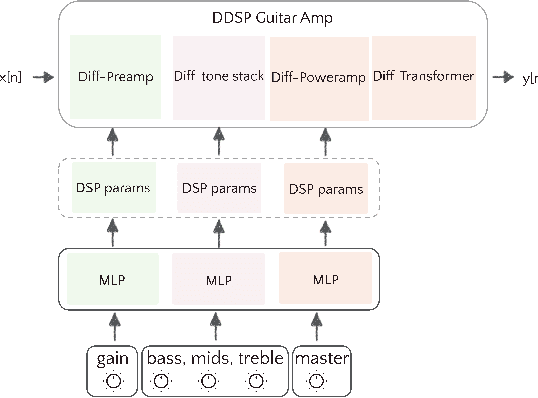
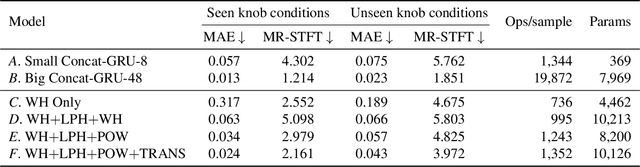
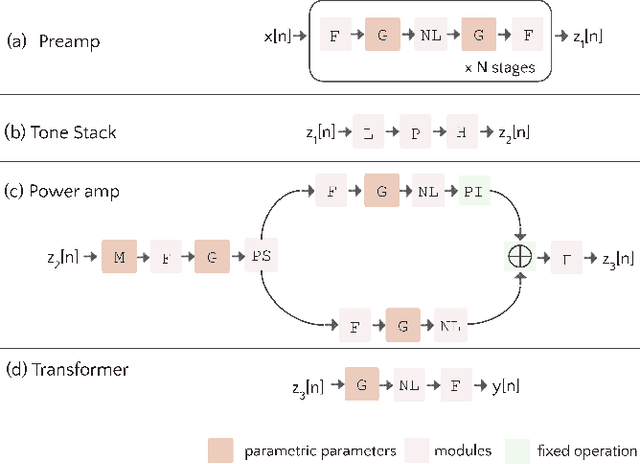
Neural network models for guitar amplifier emulation, while being effective, often demand high computational cost and lack interpretability. Drawing ideas from physical amplifier design, this paper aims to address these issues with a new differentiable digital signal processing (DDSP)-based model, called ``DDSP guitar amp,'' that models the four components of a guitar amp (i.e., preamp, tone stack, power amp, and output transformer) using specific DSP-inspired designs. With a set of time- and frequency-domain metrics, we demonstrate that DDSP guitar amp achieves performance comparable with that of black-box baselines while requiring less than 10\% of the computational operations per audio sample, thereby holding greater potential for usages in real-time applications.